
Trying to look back over 9 years of work, sleepless nights, hiring, and watching micro and macro events means I have a lot of ground to cover and disclose here. Bear with me. My hope and goals with this post are that you, dear reader, walk away with a fairly good understanding of what to expect should you start a similar journey. It's not all "peaches and cream" regardless of what the new "thought leaders" on LinkedIn will tell you. I'm going to be honest, candid, and vulnerable throughout this post. I'm a deeply passionate, emotional person, and that will surface a lot in this. Some of it will resonate with you, and some of it will probably have you leaving with more questions. That's the beauty of life: you can have both at the same time.
I'm not going to spend a lot of time talking about "customer acquisition" or "going all in on xyz". Those are covered well in other blog posts and you should absolutely read them. No. What I'm going to talk about is the foundationally emotional journey of running a business this long. The intrinsic and humanistic aspects. The shit no one else talks about, and my use of expletives here is intentional. We are not robots. We'll eschew the current corpspeak, virtue-signaling venture-slop for a real down-to-middle-earth monologue. I'm really taking a leap of faith here and I hope you can respect that and my attempt to convey it.
And one final disclaimer here before we depart on this journey: there are personal, and deeply tragic stories involved here. You might want to get your tissues ready – I'm being very serious about that. But if you can bear with me and read this in earnest, you'll definitely walk away with something. If you're already familiar with my starting story then skip down to the "Genesis, and the Early Years" section. It will save you some waterworks. With all that being said, let's get on with the show!
My Personal Background
For a solo-founded, bootstrapped SaaS startup, it's hard to separate the founder and the business at some levels. This relationship is an egregious breach of the rule "loosely coupled and separate concerns" idiom we see in software. As time goes on, they do start to loosen up, but the emotional stake never truly goes away. It's with this in mind that I open up a bit of who I am as a person in order to let you experience the full fidelity of what it's like to operate a company of this size and stature.
I am not a software engineer, nor a business leader. At least not by schooling or upbringing. The story of how I ended up here is one of consequence, tragedy, and pure white-knuckle grit. It's very important to realize who you are and your value as a person which, I've found, is an exercise that has taken me years to figure out. I thought I was just a Jazz Trumpet player – and I was professionally for a number of years – but that was all torn down with some awful news way back in 2011. Six years before browserless.
At that time my wife and I found out that we were pregnant with our first child, Toby. Moreso, we found out he had a chronic condition called Congenital Diaphragmatic Hernia. I won't go into the medical details here; use your favorite tool to find that out. I will say that the stakes were so high that a musicians salary and lack of medical insurance were working actively against us and our yet-to-be son. My wife and I saw this coming, and I spent about 8 weeks teaching myself how to code during my little free time in order to get a job with a better salary and benefits. All this in order to prepare for Toby.
To skip a bit ahead, and as noteworthy and remarkable my efforts were, we lost Toby on May 18th, 2012. We were fortunate enough to have him in our arms for about 2 hours. Even now I tear up writing about these events, these things never truly leave you. To make matters even more interesting, the following day of this loss (yes, the following day) I interviewed for what would be my first job in computer programming at a now-defunct company called Thetus. I'll pause quickly here to say a small thank you to an individual there who took such a big chance on me back then: Loren San. I had very little to my name, no degree, but he swooped me up and carried me a long way forward. Thank you.
Four paragraphs here are not enough to cover the emotional journey and hardships my wife and I endured, but it serves to paint a backdrop for what would become the Browserless journey and galvanize me as an individual. If a takeaway can be had here, it's that you can do hard things in hard times. Easy to say, much harder in practice when the fidelity of your situation takes hold.
Genesis, and the Early Years
After the loss of Toby, I pushed forward with getting myself established in programming, and I spent a number of years moving up in ranks and moving company to company. If you're curious about those details, just look it up on my LinkedIn, but please come back! To throw a rainbow over the last section: my wife and I were able to have two sons, both of whom are healthy today. I am thankful for them daily.
Growing in this career was challenging, however. I spent many evenings feverishly looking up words I heard throughout the day (orthogonal? deltas? commodities?). Amongst many other learnings, and for the sake of time here, I also started to notice common issues company-to-company with one underlying similarity. This similarity pretty roughly centered around using a browser for doing some menial "dirty-work" tasks. These "tasks" can be anything from getting data from a website, automating a site that didn't have a programmatic API, and even testing sites that (then) went through a slow process called "QA". Something about this pattern hit my curiosity, and after a series of nights I wrote a fun library called Navalia (related big first win below):
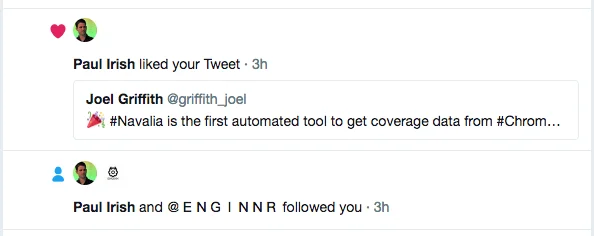
Navalia opened doors for me, and eventually I was able to chat with Paul Irish about a similar library in the works called Puppeteer that Google had been working on. It was unreal to be involved in those conversations! I immediately saw the value in this library as it solved many pains of yesteryear with the above uses I saw for browser automation. It was an exhilarating project to have a small part of! But it was impossible to run sanely in a cloud or VPS environment. It either straight-up didn't work, or worked so poorly it was almost a joke. At the same time, a technology called "Docker" was really hitting its stride and enjoying broad adoption. So I did as any sane engineer would and solved two problems with one motion: get Puppeteer working well in Docker… and learn Docker!
I pivoted from my current side-project, small web-app with an infamously low-effort gift registry tracker, into making hosted browser automation a thing. Even nine years later, I still vividly remember those long nights on the crap-tastic brown futon upstairs, hacking and building Docker images until two o'clock in the morning. Long live the hackers!
Those early "aha" moments would act as rocket fuel to push me through the challenges that were to come ahead, and it was well worth the lack of sleep. Once I had a working container and wrapped my head (quickly) on setting up a business, I had the MVP in place for what Browserless would become. Witness the first dashboard and account portal, complete with old logo, in all its glory!
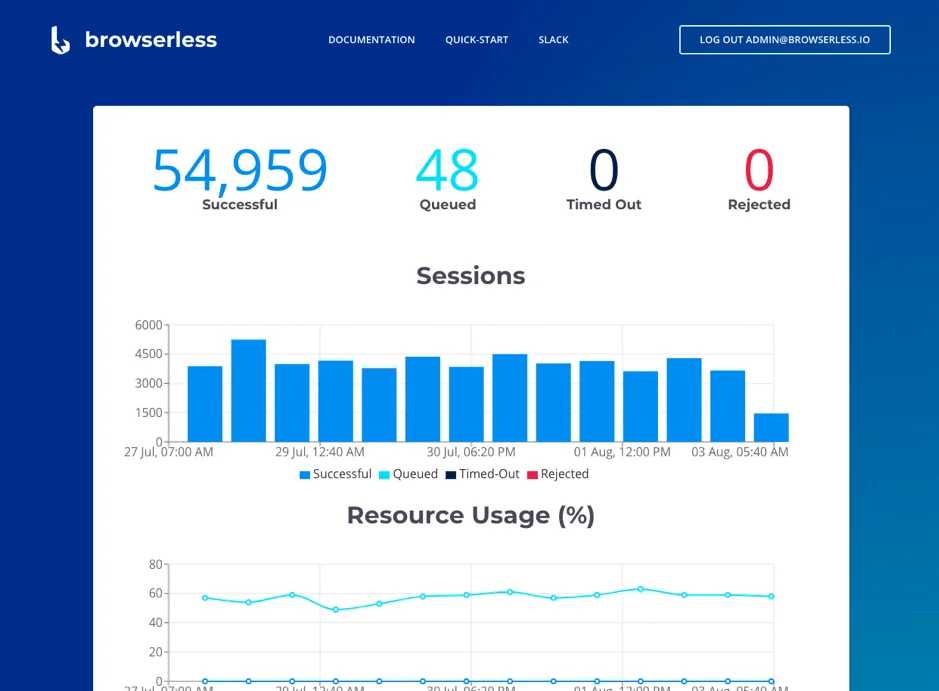
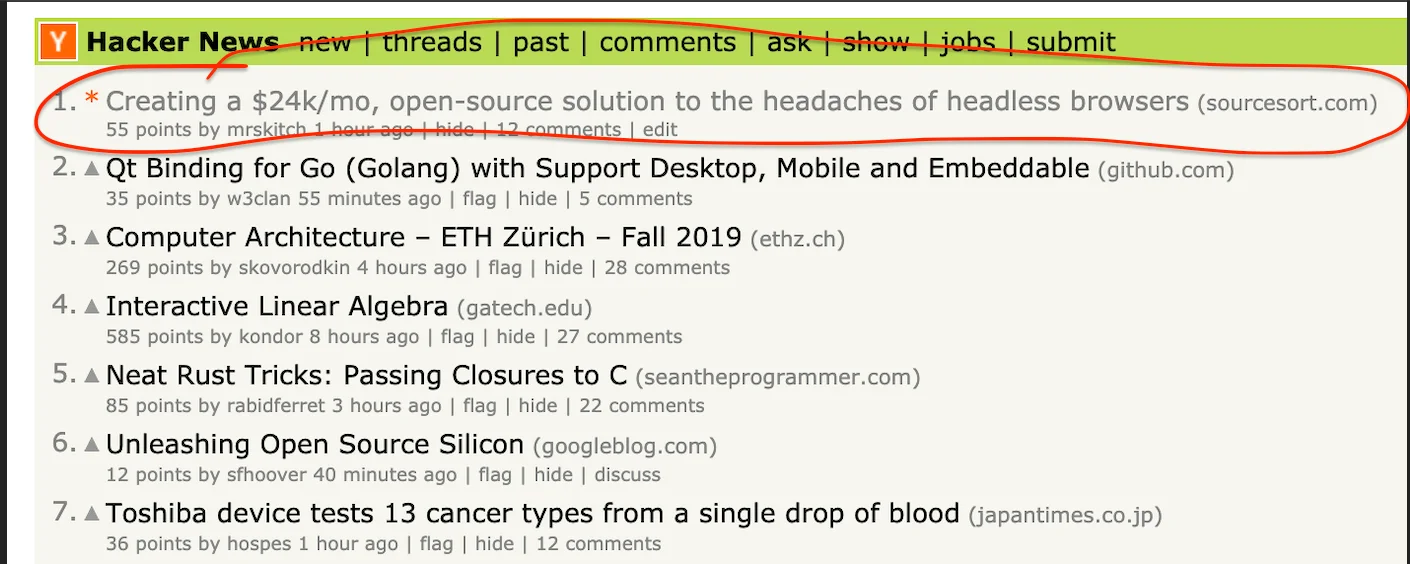
In about two weeks I had my first paid customer from a simple GitHub issue. And then another. I then started writing about my experience and posting it in blogs and online forums. Bending the rules a bit with sites like Stack Overflow, Reddit, and others to squeeze every ounce of growth possible. Years of this compounded and added to what I'd eventually learn is "domain authority". Add in a few big wins from posting on various communities and things were off:
Enter the Polychrome partnership
Several years had now passed since the start of the business. COVID came and I was working two jobs still: Browserless & Elastic (yup that Elastic). I was stressed: young kids, a growing business, and a full-time job. I was still the only employee at this point, and was doing it all: marketing, sales, engineering, etc. Yeah… it kinda sucked. And no AI (aside from me).
But then by happenstance came along a group of folks who would be absolutely instrumental in Browserless' success: Polychrome. These fresh-faced individuals- Matt, Greg, and Alex- had just started their own holding company and wanted to help people like myself grow their fragile business into full-fledged companies. As a very skeptical individual, I was… skeptical. Their timing couldn't have been better though, as the largest-ever deal at the time (5-figure ARR) was in my pipeline and I was losing my mind trying to navigate it and not show my ever-growing imposter syndrome (What's a redline? What's an MSA?). Polychrome's model for partnership was a unique one at the time, at least to me: they come in with a founder-mentality and mindset, to help grow the business. We had great alignment, started the partnership, and closed that 5-figure deal. Oh, and we hired our first employees (hello Alejandro and Anderson!).
With renewed vigor, and now a team involved, browserless was well poised to springboard and truly be a company that I had wanted to work for. We closed deals with the likes of codepen.io and many more (sorry… NDAs and all that), and thus the journey really took off. I said a heartfelt goodbye at Elastic, and went browserless with full force.
Side note: aside from the genesis of the company, this was one of the funnest and most fulfilling times. Getting others involved, waking up to work being done, and the excitement in the Slack channel really kept me engaged. The journey is the destination for bootstrapped businesses, so hold onto that if you find yourself here.
AI and VC's Begin to Wake Up
Things were going swimmingly for a few years: deals were closing, I bought a new car(!), and Greg drank a lot of negronis (cheers!). But then a competitor showed up with a lot of money – Browserbase. I was scared and upset; it felt so close to what I had already built with this team, and now I felt was all at risk. But then another competitor showed up! And then some more! Then this thing called LLMs took off and the table flipped on its head. I was starting to feel like we might be cooked: how could a small bootstrapped startup ever compete with the big VC's out there in what we'd eventually call the "AI-era"? (spoiler: we're doing alright). We were such a small boat, and were in a tsunami with battleships.
And this is where I had my first wave setbacks: loss of market share, new competitors, and the slow rot of personal burnout. Sadly, I was too much on the "AI is just a new crypto" mentality and didn't see the value. I was deeply mistaken looking back. As more time passed by, I wrongfully ignored what was going on, and competitors started to catch up, and eventually eclipse our ARR. If you look at the spoiler link in the above paragraph, you'll notice there are a lot of competitors for such a niche service, IMO. However, and thankfully, the business that we did win really loved us. We treated them as much like family as possible, jumped into the trenches with them, and learned alongside them. I can't emphasize this enough: if you can not only show up for what you're trying to solve, but also solve a bit more of their problem set, you will absolutely have a customer and friend for life. Thankfully even though ownership of market share was going down, the total addressable market was going way up (gestures broadly at AI), so all was not lost.
Now you'll probably assume this is part where we have our comeback moment. I'm sad to say that that is not the case, nor is it just yet (maybe on the 10-year review!). Unfortunately, the aforementioned feelings of burnout had not only taken hold, but accelerated from this new pressure. Well, that's not true actually. I was well within burnout at that stage. We hired some amazing performance-oriented folks to help grow more, and were fighting for every last ounce of market share. But as the founder of a company, you kind of act as a metaphorical "pressure regulator" for the rest of the team. If you aren't hustling, they aren't motivated either. It's that odd entanglement that I mentioned above, back to haunt me!
To try and combat my dwindling mood and spirit, I took an entire month off in April of this year, which, while amazing, wasn't fundamentally my core issue, nor did it solve much. I was stuck, frustrated, and lost in what I was doing, why I was doing it, and questioning the very reasons I got into software to begin with. Other personal matters were involved here as well, but I'll save those for my own reasons. I will say that grief has this really amazing quality of coming back and haunting you years later, which was also happening. Much like Mal from Inception, if you are aware of that film. I was a fully blocked person, struggling to express anything other than going through the daily motions. It fucking sucked big time.
The Transforming Power of an Offsite
Fast forward to just a week ago, I had the fortunate opportunity to attend Polychrome's annual offsite in Spain. Other portfolio companies were also in attendance: Flagsmith, Marker, Stategraph, and Dokploy (welcome!). Up until this offsite, I was bearish on their use and value. It's time away from family, a long flight for me, and involves quite a bit of work with presenting. To say I was heading into it with the not-best-of-intentions would be quite the understatement. At my core, I was hesitant to go and was already looking forward to coming back. To all the companies and Polychrome: I'm sorry for whatever attitude I might have walked in with and for masking this from you.
But something that I can only characterize as magic happened. Truly, I don't have the words for what transpired, but somewhere and somehow many of my burnout ailments were dissolved. The sessions were amazing; the people were incredible; and the conversations, jokes, and candid-but-emotional chats made something "click" in a way that I can only describe as transformational. I kid you not, I left that offsite a different Joel, completely unblocked from whatever held me back before. Years of compounded advice, therapy, and more simply "pushed through" during that week, and it finally made more than just sense. These teachings were assimilated. The connections, laughs, and emotional hugs and cry-out sessions are something I wish I could replicate. It's likely that this will never happen again in such a powerful way, and I'm forever thankful for it. My farewell message in Slack had some of the kindest, most thoughtful messages I've received in a long time. I see you all Polychromiums!
The best way I can describe this feeling is a chrysalis moment in my journey. All those years of trial, death, imposter, fatigue, pandemics, therapy… it all served to create this emerging of myself in a way that I can only describe as borderline religious. I wish I had some advice or anecdotes here. I guess get out there, find a network of humans, and commit deeply to that network. Your support network and people will be your salvation as a founder.
Ok, that's all done now, and this brings us to the present!
The Future and Where We're Going
First, thank you for entertaining this old-man monologue of mine. If you made it this far, sincerely, thank you.
I have never been more excited about the future of Browserless. I'll say that again, I have never been more excited about the future of Browserless. We have something here that is special and can do things that our competitors can't even dream of doing, nor will their investors let them. I believe we have the right mix of grit, fervor, and values that will make us the partner to go with should you need some level of web automation. Why, you ask?
We've done it for 9 years, we're winning business, and we're still sprinting forward. Browserless can work more flexibly than any others: self-host, private cloud, shared cloud, choose your cloud even, and of course, forever-free accounts. You don't even have to talk with us, just go download the Docker containers and get cranking: github.com/browserless/browserless/pkgs/container/multi.
We've got what your agents, developers and biz-owners crave: MCPs, REST APIs, multi-browser support, library support, 1Password, payments, recordings, skills, and even our own new bespoke library that'll crush anything out there (biased beaver here). Soon we'll have our own self-hosted harness as well, freeing you from the tyranny of frontier models. No matter how you automate, you can automate the fastest and most successfully with Browserless. Best of all is we're practically bulletproof in the event of an economic downturn. We are self-funded, with unlimited runway, and are found just about in every marketplace on the internet.
Ok, I'm done pitching 🙂! Thank you for staying with me on this. I hope you've learned something here!
Takeaways
If you've skimmed up until this point, no shame! I've still got things to recommend and comment on. And, as a special treat, It's in short form!
Trust deeply, your own instincts
There's going to be a time you don't know why you feel a certain way. There's a subconscious survival trait kicking in here. Might wanna pick up and listen to it.
You can carve your own path and have it both ways.
I remember thinking a lot about wanting to support a family and having a comfortable life. I thought that these two things were incompatible, and some might think that, but they're not. Jack Conte of Pomplamoose is both the CEO of Patreon and a celebrity in the indie music space. You can do both. There are people today who are.
Embrace the energy even if it comes with fear.
Engineers in particular won't ship something if they don't have all the edgecases handled. Guess what, all the edgecases are never going to be fully handled. It's better to make a move than be frozen in analysis paralysis.
Trust people who are more skilled than you
This one is mostly there for those solo founders. As someone much smarter than me once said: "You can go fast alone, but you can go further together." Get over yourself and let people have a chance.
You can achieve two things with one effort – look for them
A feature that solves two bugs, a design choice that makes the "wrong" thing harder and improves systems. Look for opportunities that bear two wins.
Don't sacrifice your values for convenience… or money
Learn what the motives are – especially for investors. I was really lucky here when bringing on partners. I know of many who aren't.
Now, in closing, some much needed recognition of the people who made me what I am today.
Thank Yous
I, and by proxy Browserless, have a lot of people to thank. In no particular order, here they are: April Buchtel and Joseph Griffith (Hi Mom and Dad!), Mike Perham, Jonathan Siegel, Patrick McKenzie, Joel Spolsky, Greg Lazarus, Matt Althauser, Alex Boswell, and most importantly, everyone working at browserless who took a bet on me. Thank you, deeply.
One More, For Sarah
It's hard to say how truly thankful I am for this next person. If anyone is deserving of recognition in all of this, it's my always and forever partner, Sarah Griffith. Years upon years of her sacrifice, support, and insight have made me a lot of who I am today; and by consequence, what Browserless is. Sarah, you are a fierce spirit, a true confidant, and everyone I know values your friendship and insight. So many nights she's had to deal with my rambling, crying and challenges. She even suffered an outage on our 15-year anniversary, on a far away trip, and was nothing but supportive(!). If I can suggest a second thing to those reading it's invest heavily into the person you partner with for the rest of your life. Finding the right person will only magnify what you are truly capable of – and be there in life and death. Sarah: I love you always and forever, without condition.
I'll part with these words that I recite to myself almost daily, from a movie that I honestly don't much care for, but says it so well:
"We are the music makers, and we are the dreamers of dreams." Chills…
Keep your entropy low,
Joel Griffith