
TL;DR
- The core difference. GraphQL vs. REST comes down to who decides the response shape. REST spreads data across fixed-payload endpoints, while GraphQL has one endpoint and lets your query define exactly what data comes back.
- The trade. REST buys you predictable costs and HTTP caching that works by default, at the price of extra calls to assemble one record, while GraphQL buys you fewer round trips and a payload shaped to your needs, at the price of harder caching and queries that need limits.
- When you don't get a vote. If you're scraping or automating against someone else's site, their team already chose, and your job is to work with whichever shape you find.
Introduction
GraphQL vs. REST is a question you'll hit whether you create APIs yourself or consume someone else's. Both usually exchange data as JSON over HTTP, though neither requires that transport, and the one you pick shapes caching, versioning, error handling, and how many calls it takes to fill a single screen.
You won't get a verdict here, just a decision framework you can take back to your team. It walks through how data fetching, caching, versioning, error handling, and pagination actually behave in each, when to reach for one over the other, and whether you need to pick a side at all. It ends on the case where the API isn't yours at all.
REST vs. GraphQL: comparing two API architectures
Let's start with what goes over the wire. That's where the difference lives, and everything else follows from it.
REST is resource-shaped
A REST API follows representational state transfer (REST), an architectural style for web services built around endpoints that each map to an existing server-side resource, like products, reviews, users, or orders.
You run data operations on them with the standard HTTP methods, GET to read, POST to create, PUT to replace, DELETE to delete data, and the server tells you how it went with a status code. You've almost certainly built one, since those are the common API architectural principles behind traditional REST APIs.
GraphQL is query-shaped, built on a GraphQL schema
GraphQL is an API query language, not an architectural style. Facebook built it to produce news feeds efficiently on mobile, where every extra round trip showed.
The client sends a query document naming exactly the data it wants, and the GraphQL server hands back a response in that shape. Most GraphQL APIs sit behind a single endpoint, so client requests can pull an entity and all its related data in a single request.
So REST leans on HTTP verbs, and GraphQL lets the client name what it wants. Here are the key differences, and where each one starts to bite in practice.
| Factor | REST | GraphQL |
|---|---|---|
| Mental model | Multiple endpoints, one per resource, so REST enables client applications to reason about one thing at a time | One endpoint, query decides data shape |
| Over-fetching | Common, because a fixed payload returns every field whether you need it or not, so you pay for unnecessary data transfer | Less common, because the client asks for only the data it wants |
| Under-fetching | Common, because assembling one record can take multiple REST API requests across several endpoints | Less common, where the GraphQL schema exposes the relationships you need to follow |
| Versioning | Often via URL or headers (e.g., v1, v2) | Schema evolves through deprecation and additive changes, which preserves API backward compatibility |
| Caching | Straightforward, since HTTP semantics let you cache frequently accessed data at the edge | Harder, since responses depend on query shape |
| Error patterns | Status-code driven, with details in the error body | Often 200 with an errors array, so one response can carry partial data and the failure together |
| Tooling | Universal HTTP tooling in any programming language | Great typed tooling if the schema is available |
| Governance | Mostly endpoint-level | Needs query limits, complexity controls, and persisted queries |
| Debugging | Trace by endpoint and params | Trace by query, variables, and resolver behavior |
| Real-time | Polling, webhooks, or server-sent events | Subscriptions, for streaming data updates over one connection |
GraphQL can feel faster for complex data structures, since you can collapse several resource requests into one and aggregate related fields in a single response.
That flexibility carries an operational price of its own, and caching gets trickier, query governance matters more, and a poorly controlled query can create tail latency you'll only see under production load.
Error handling in practice: what the GraphQL server sends back
That row is the one that trips up almost every team the first time, so it's worth slowing down on. A REST API leans on the HTTP status code itself to tell you what happened, so a 404 means not found, a 429 means slow down, and a 500 means the server broke. You can branch on the status code alone, and your tooling can automatically identify request errors, before anyone parses the body.
GraphQL flattens that signal, and you'll very often get an HTTP 200 even when something inside the query failed, with the failure tucked into an errors array next to whatever data did resolve.
That's a real gift for partial failures, since one nullable field in a nested query can fail without taking the rest of the response with it. Mark that field non-null, though, and the error climbs to the nearest nullable parent instead, and the whole subtree goes with it.
The other cost lands on your error handling, which now has to read data status out of the response body on every call rather than trusting the HTTP status code. If your team grew up on REST's status-code-first mental model, that's the single biggest habit you'll have to unlearn.
Data fetching in practice: the same job, two shapes
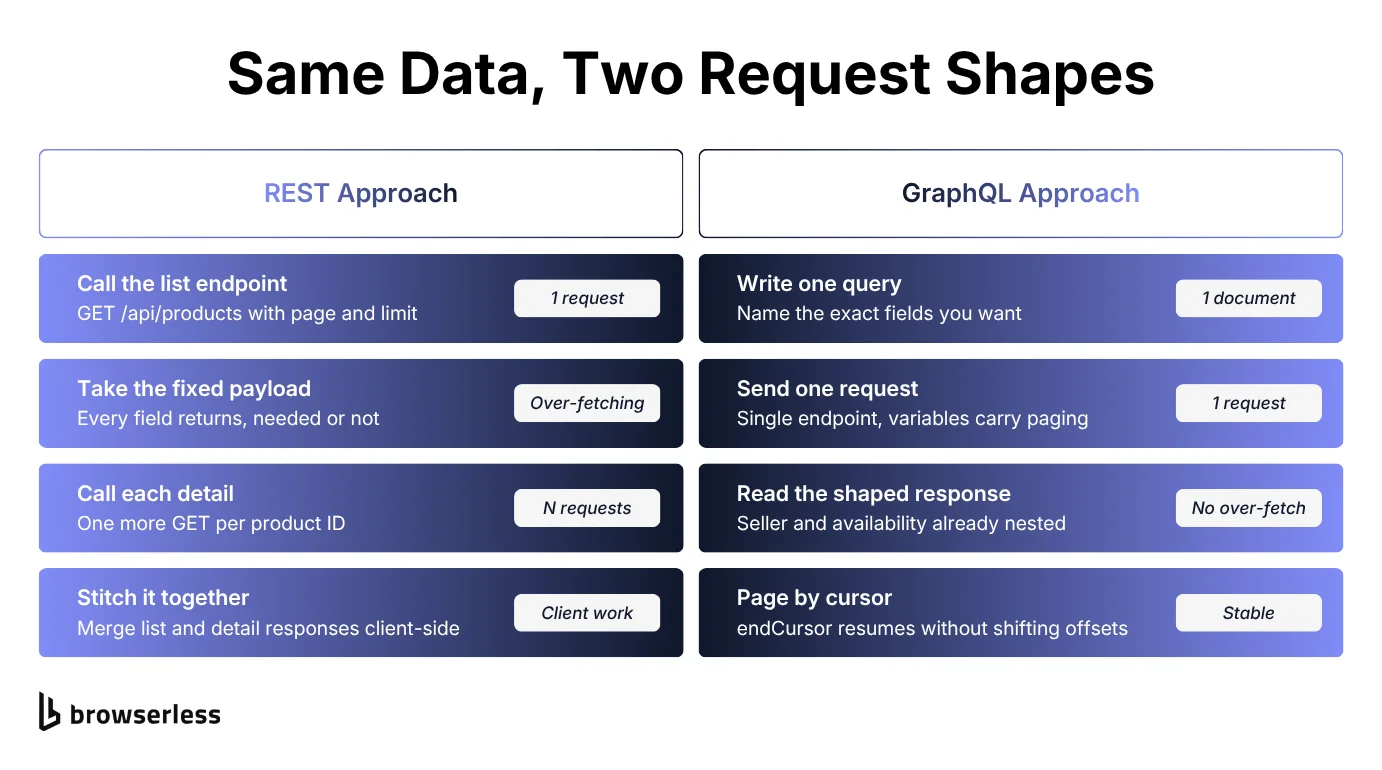
Take a workflow you've almost certainly built, where you fetch a list of items with the fields you need for scoring, then fetch details for the top results.
The REST approach: multiple calls, fixed payloads
Against a REST API, that's a list call followed by one detail call per item you care about. The example below runs as printed against DummyJSON, a public demo API, and the same shape works on any REST target once you swap the base URL and add whatever auth header it wants.
BASE_URL="https://dummyjson.com"

# 1) Fetch list
curl -sS -X GET \
  -H 'accept: application/json' \
  "$BASE_URL/products?limit=25&skip=0"

# 2) Fetch details per product
curl -sS -X GET \
  -H 'accept: application/json' \
  "$BASE_URL/products/1"

curl -sS -X GET \
  -H 'accept: application/json' \
  "$BASE_URL/products/2"
That's predictable, and easy to reason about one call at a time. It also nudges you toward one of two familiar failure modes, either endpoint sprawl, where every screen ends up with its own specialty endpoint, or under-fetching, where assembling a single record takes multiple requests.
The GraphQL approach: one query, shaped payload
The same job against a GraphQL API is one document. The query names the list, the paging fields, and the nested seller and availability data in a single place, while variables carry the page size and the cursor.
query ProductListWithDetails($first: Int!, $after: String) {
  products(first: $first, after: $after) {
    pageInfo {
      hasNextPage
      endCursor
    }
    nodes {
      id
      name
      price
      rating
      seller {
        name
        reputation
      }
      availability {
        inStock
        deliveryEstimate
      }
    }
  }
}
Only one API request replaces three, nothing needs stitching afterwards, and the payload arrives in the shape you wanted in the first place. On round trips alone, GraphQL wins this one outright.
Governance is where GraphQL gets expensive if you let it. Complex data querying is powerful, but without query cost limits, persisted queries, depth limits, and field-level controls, a query written in the GraphQL query language can grow unbounded, and an unbounded query is an unbounded bill, whether you pay in time, compute, or blocked requests.
Payload shape, data exchange, and contracts
GraphQL hands you control over the response shape. That pays off when you're enriching entities and need nested data, but it also means the responsibility for data retrieval is now yours.
REST pushes you toward a standard response per endpoint instead. That's boring, and in production boring is exactly what you want, because a stable contract usually beats a flexible one. Given the choice, take the contract that still holds in six months over the one that feels elegant today. Integrations outlive the people who wrote them, and a stable endpoint contract is easier to keep honest than a query shape any client can change.
When to use GraphQL vs. REST
Once you've seen the calls side by side, the decision stops being about elegance and starts being about costs you can measure. You're trading GraphQL's flexibility against REST's simplicity and the well-worn patterns that come with it.
Choose GraphQL when...
- The server enforces query cost or depth limits, so one careless query can't take everything down with it.
- Your data is genuinely nested and composable, products plus sellers plus availability, and you would otherwise stitch it together client-side.
- You can rely on cursor pagination (covered below) and stable identifiers.
- Query text lives in version control, where you can diff and review it like any other code.
Choose REST when...
- You want predictable per-request costs, with each REST API call small and bounded.
- You lean on HTTP caching and standard reverse proxy behavior.
- The target's API surface is already clean, with a list endpoint and a detail endpoint that don't change weekly or version without warning.
- Your team's tooling is built around REST, with simple clients, easy replay, and straightforward monitoring.
Can you use GraphQL and REST together?
Real systems rarely run all their data services on one architecture for life, and bolting on GraphQL almost never means retiring existing API architectures. Running both side by side is common, and it's rarely an accident. The two solve different problems well enough that mixing them is usually the pragmatic move rather than a compromise.
One split that shows up again and again:
- Public REST – health checks, static reference data, webhooks, and anything that benefits from standard HTTP caching and doesn't need a flexible query shape.
- GraphQL BFF – an aggregation layer, or backend-for-frontend (BFF), sitting in front of multiple data sources, whether your own REST services or third-party ones, that gives client apps one flexible endpoint instead of forcing them to stitch together multiple calls themselves.
- Split by audience – GraphQL for internal tooling and REST for the public-facing surface, keeping your external contract simple and cacheable while your own teams get the query flexibility internally.
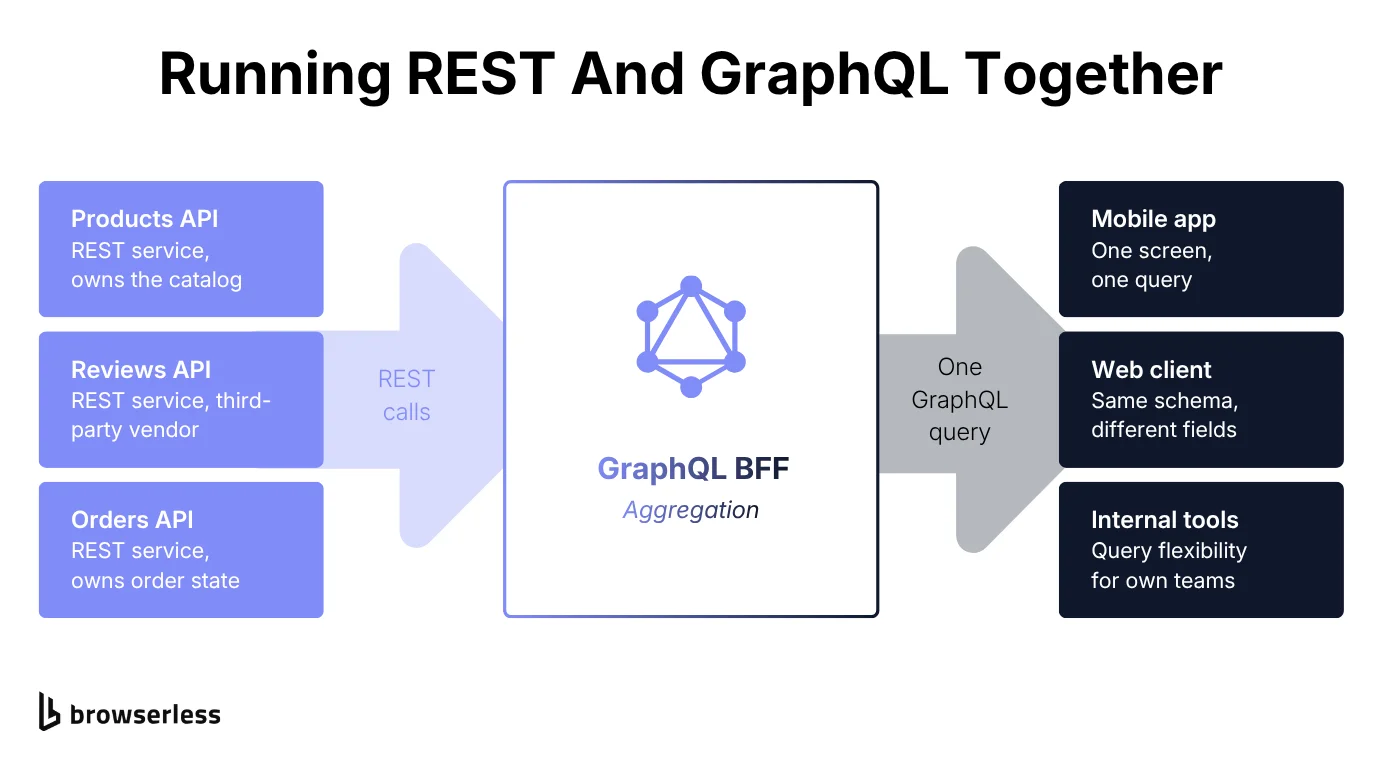
What you pay for it is surface area, because you're now maintaining two API styles instead of one, with separate auth, versioning, monitoring, and API documentation to keep in sync.
That's worth paying when the aggregation problem is real, say a mobile app assembling one screen from five backend services. It isn't worth paying just because GraphQL is there. If a single REST endpoint already answers the question cleanly, a GraphQL layer on top is one more schema for you to maintain and nothing to show for it.
Scraping GraphQL APIs vs. REST endpoints: an applied example
Everything above holds whether you're designing your own API or consuming someone else's. There's one situation where the choice was never yours to make, and that's when you're scraping a site or automating against it and simply consume whatever it exposes, whether that's REST endpoints, a GraphQL API, or both.
In practice you'll end up in one of two modes:
- Direct API calls – when the site's internal APIs are stable enough and you can authenticate, REST or GraphQL, and you don't get a vote.
- Real browser – when the site is JavaScript-heavy, gated behind bot protection, or requires multi-step interaction – then extract either DOM content or the underlying network responses.
The mechanics depend on what you're reverse-engineering. List pages often trigger a list API call, then additional calls for facets, pricing, availability, personalization, and tracking. Detail pages usually pull nested data, meaning item core fields plus related entities like seller, shipping, images, variants, and reviews.
In a single-page app (SPA), one user action or route change often kicks off several background network requests to load data, and they rarely come back in similar data formats, with one call returning JSON while another hands back HTML fragments or other data formats entirely. That makes naive HTML parsing brittle unless your scraper waits for the right calls to resolve.
Working without API documentation
REST mechanics are route, verb, and params. In scraping, that typically means you reverse-engineer a handful of endpoints, then build a fetch loop with pagination and retries.
GraphQL mechanics are query and variables, plus schema constraints if you have introspection access. In scraping, you often copy a query shape from DevTools, then replay it to request data for new entities. When the schema holds still, this is the easiest extraction you'll ever write. You name only the exact data you want, and the server returns JSON data in exactly that shape, with nothing left for you to reshape afterwards.
The big difference is that GraphQL can hand you a strongly typed API architecture, with a schema, validation, and better tooling for client development, but only if the target site hasn't locked down introspection and the schema stays compatible over time. When you do have it, the schema is often written in the GraphQL schema definition language (SDL), where you define data types and their relationships in one place, so the whole model is laid out for you.
Running both: Browserless REST APIs and BAP
The same split shows up one level up, in whatever you drive the browser with. Browserless exposes both shapes on one platform, so you can decide per job instead of per stack:
- Its REST APIs cover single-purpose browser tasks, such as taking a screenshot, generating a PDF, or scraping selectors from a rendered page with one POST to
/scrape, with/smart-scrapefor pages that fight back, which comes up again below. - BAP, the Browser Automation Protocol, covers the jobs where the workflow is the hard part. It's a typed TypeScript SDK shaped like Puppeteer, so you write navigation, waits, and extraction in code you already know. Stealth, proxies, and CAPTCHA solving are opt-in: switch to the
/stealth/bqlendpoint for stealth, and callpage.proxy()orpage.solve()when a job needs proxies or CAPTCHA solving.
Underneath, every BAP call compiles down to BrowserQL (BQL), the GraphQL protocol that drives the engine, which is why it belongs in this comparison at all. Reach for BQL directly when you're on a language without an SDK or you want the GraphQL API itself, and treat BAP as the front door the rest of the time.
A scheduled screenshot job can use the REST endpoint while a multi-step scraping workflow uses BAP, without changing platforms.
GraphQL vs. REST performance, cost, and rate limits
Once a job runs on a schedule rather than in front of a user, the comparison shifts. What you care about now is throughput, what each run costs, and how the target reacts when you ask it for a lot.
GraphQL vs. REST for data retrieval in pipelines
In pipelines, GraphQL's big win is efficient data fetching through batching, which means fewer round trips and less orchestration code to fetch data. That pays off most in enrichment stages, where every entity needs several related fields.
You pay for it with the same controls covered above, query cost and depth limits plus deprecation-based schema evolution, and a client-side cache that's harder to get right when two queries overlap but aren't identical.
If your job is a scheduled task and predictable throughput is what you care about, REST is still the calmer choice. If your pipeline feeds a feature store and needs rich entity graphs, GraphQL earns its extra controls.
What actually drives performance and cost
Fewer requests can help, but it's not magic. In practice a handful of things dominate:
- Execution time – GraphQL can push work into resolver logic; REST can push it into multiple endpoints.
- Payload size – GraphQL only reduces it if you actually select fewer fields.
- Caching – REST often wins here by default; GraphQL requires extra strategy.
- Geography – latency hurts more when you need multiple calls.
For automation and scraping, one factor outweighs all four. Render-heavy jobs bottleneck on browser time, not request count, so while you're waiting for a page to paint, the query style you picked barely registers.
Cost follows the same logic, scaling with total work, which is how many requests you trigger, how much data you transfer, and how long you keep a browser session alive. Three levers move both numbers:
- Prefer direct API extraction when the target API is stable and you can replay it safely.
- Cut browser runtime per job by waiting on a specific response or selector instead of sleeping.
- Reuse sessions for flows that need continuity, with the caveat that a session which looks too consistent is itself a bot-detection signal.
On Browserless, stealth is opt-in. BQL picks it up from the /stealth/bql endpoint and takes proxy=residential as a launch parameter, while BAP sets proxies with page.proxy() and humanizes click() and type() by default. If you're running your own Puppeteer or Playwright scripts on Browsers as a Service (BaaS), the stealth route gives you the same fingerprint hardening.
What to use for rate-limited sites: GraphQL or REST?
Rate limiting is where the clean theory of REST vs. GraphQL breaks down.
- REST is usually throttled per REST request, counted per minute, per endpoint, or per IP.
- GraphQL is sometimes limited by query complexity or depth, though plenty of implementations still apply blunt per-request throttles.
Servers process API requests at whatever rate suits them, and both styles will throttle you hard the moment you look suspicious. A few tactics work either way:
- Exponential backoff with jitter.
- Concurrency caps per host and per account.
- Caching and deduping so you don't re-fetch known entities.
- Request shaping, meaning fewer fields, smaller pages, and predictable patterns that keep you from over-fetching.
- Stable identifiers and checkpointing so you can resume without starting over.
How to handle auth and pagination in GraphQL and REST
Auth and pagination are where reliable integrations separate themselves from scripts that only work on your laptop.
Auth patterns you'll see in the wild
Both REST and GraphQL APIs lean on the same handful of auth patterns:
- API keys.
- OAuth access tokens.
- Session cookies after an interactive login.
- Cross-site request forgery (CSRF) tokens tied to cookies.
- Rotating headers, sometimes per session and sometimes per request.
The main difference is visibility:
- In REST, auth can vary by endpoint, especially where some endpoints are public and others are private.
- In GraphQL, there's usually one endpoint, so auth failures concentrate in one place and are easier to spot. Token scope gets subtler in exchange, since that single endpoint covers many fields.
Driving a real browser makes most of this simpler. You log in once in the browser context, then replay requests with cookies and headers that already look like a real session.
That's often the shortest path when auth is tied to client-side flows rather than a header you can set. The login happens the way the site expects, and you never have to rebuild it by hand. When a job needs that logged-in state to outlive a single run, Browserless persists it through the Session API, which takes a ttl for how long the session should stay alive.
Pagination: page/limit vs. cursor pagination
Pagination is one of the REST vs. GraphQL differences that shows up fastest in production.
REST pagination often looks like:
?page=3&limit=50
?offset=100&limit=50
Offsets are easy to write and fragile the moment the data moves. One insertion on page 1 shifts everything after it, so you either miss items or collect them twice unless you dedupe on your side.
GraphQL pagination often uses cursors:
first: 50, after: "cursor"
Cursors survive all of that, which is what makes them the better bet for resuming a job without collecting the same record twice.
Whichever one you're stuck with:
- Always store a checkpoint – cursor or last-seen ID.
- Always dedupe by a stable primary key.
- Prefer deterministic ordering, even if it costs you a sort field.
What this looks like with Browserless
A plain fetch-and-parse platform is fine when:
- You're scraping simple pages with stable selectors.
- You want one endpoint that returns one response body with minimal data exchange.
- You don't need interaction, network capture, or complex waits.
Modern scraping often needs more than fetch-and-parse, though. SPAs load their data late, flows require clicks, scrolls, or form submissions, pages render blank unless JavaScript runs, and anti-bot friction punishes repetitive patterns.
The awkward part is that you rarely know which case you're in until the page fails.
That's the gap the /smart-scrape endpoint closes, with one REST call that escalates from a fast HTTP fetch through a proxied request, a headless browser, and a browser with CAPTCHA solving, depending on what the page turns out to need, so the decision is made per request rather than per pipeline, and the response's strategy and attempted fields tell you which rung it landed on.
Start with the REST shape, where a /scrape call posts a URL and a list of selectors and Browserless renders the page before extracting anything:
curl --request POST \
  --url "https://production-sfo.browserless.io/scrape?token=$BROWSERLESS_API_TOKEN" \
  --header 'content-type: application/json' \
  --data '{
    "url": "https://example.com/",
    "elements": [{ "selector": "h1" }],
    "gotoOptions": { "timeout": 10000, "waitUntil": "networkidle2" }
  }'
What comes back is JSON with a data array holding one entry per selector. Each entry has a results array of the matched elements, and every result carries that element's text, HTML, attributes, and position on the page. There's no browser for you to manage and nothing to tear down afterward.
The BAP equivalent reads like Puppeteer, and it wants to live in an ES module (.mts, or "type": "module") since it uses top-level await. You connect, open a page, navigate, and pull text from a selector, and the try/finally releases the session even when a selector never shows up:
import Browserless from "@browserless.io/bap-ts";

const browser = Browserless.connect({
  browserWSEndpoint: "wss://production-sfo.browserless.io/chromium/bql",
  token: process.env.BROWSERLESS_API_TOKEN,
});

try {
  const page = await browser.newPage();
  await page.goto("https://news.ycombinator.com", { waitUntil: "domContentLoaded" });
  const headline = await page.$eval(".titleline");
  console.log(headline);
} finally {
  await browser.close();
}
It isn't a drop-in for Puppeteer, since it runs over BrowserQL rather than a live Chrome DevTools Protocol (CDP) session and the method set is the subset BQL can express, but for scrape-and-extract jobs that subset is the whole job. Each method builds a BrowserQL mutation and sends it over the WebSocket, so the same script, written as the protocol itself, is one mutation:
mutation ScrapeHN {
  goto(url: "https://news.ycombinator.com", waitUntil: domContentLoaded) {
    status
  }
  firstHeadline: text(selector: ".titleline") {
    text
  }
}
The navigation status and the extracted text arrive together in one response, so there's no second call to correlate.
When the target's data lives in network calls rather than in the DOM, the response mutation returns the responses the browser received, filtered by URL pattern. That's often the fastest path to clean JSON, as you're reading the API the page itself called instead of rebuilding it from rendered HTML.
Conclusion
Treat GraphQL vs. REST as a decision framework rather than a loyalty test. REST is the calmer option when you want predictable, cache-friendly calls and simple operational reasoning. GraphQL earns its extra controls when you need nested data and fewer round trips. When you're consuming an API you don't control, for web scraping, integration, or automation, that decision was already made for you.
Browserless covers both shapes, so the choice stays a per-job one, with REST APIs for straightforward browser output and BAP when the workflow itself is the hard part. Start with a REST scrape, then move to BAP when the page stops cooperating. To try that against a real target, sign up.
GraphQL vs. REST FAQs
Is GraphQL replacing REST?
No, and it isn't trying to. GraphQL took off as an aggregation layer that sits in front of REST services, not as a replacement for them, and the pattern that has stuck is the two side by side. Public, cacheable endpoints tend to stay REST, while screens that stitch together many sources get a GraphQL layer.
Is GraphQL faster than REST?
It depends entirely on where your time goes. GraphQL wins when a screen would otherwise need several round trips, and REST wins when HTTP caching can serve a request without touching your servers at all. For browser-driven jobs the question barely matters, because rendering the page costs far more than the request shape ever will.
Can you cache GraphQL responses?
Yes, but you have to work for it. A plain GraphQL POST looks identical to every other POST, so CDNs and proxies can't cache it the way they cache a REST GET. Persisted queries fix that, since the client sends a stable hash over GET and the edge can cache the result, and client libraries add a normalized cache on top for repeated fields.
Does GraphQL work with an existing REST backend?
That's the most common way it gets adopted. Each GraphQL resolver calls the REST endpoint it wraps, so the REST services keep running unchanged while clients get one endpoint and one schema. You can migrate a screen at a time and never do a big-bang rewrite.
Is GraphQL harder to secure than REST?
It shifts the work rather than adding to it. Auth is the same, with tokens or cookies on every request, but a single flexible endpoint needs limits a REST API gets for free from its fixed shape. In production that means turning off introspection, capping query depth and complexity, and rate limiting by query cost instead of by request count.