
TL;DR
- Best CAPTCHA solver. A CAPTCHA solver takes a challenge your script can't click through and returns a token your automation can submit, and the right one depends on whether you're building a Python script, an API-first pipeline, or a browser extension.
- Rated independently. All 8 tools carry a GitHub star count or a review-platform score, never a vendor's self-reported accuracy number.
- Dedicated APIs. 2Captcha, Anti-Captcha, CapMonster Cloud, and DeathByCaptcha cover the broadest type range, and CapSolver leads on Python.
- Free extensions. Buster and NopeCHA solve in the browser with no API key, though Buster handles audio reCAPTCHA only.
- Where Browserless fits. When a CAPTCHA interrupts automation you're already running, solving is built into the same session rather than a separate vendor integration.
Introduction
Search for the best CAPTCHA solver and nearly every result is a listicle written by one of the tools it ranks first. That's not exactly dishonest, it's just how the category works. A solving service has every incentive to publish the comparison and put itself at the top, whether you're evaluating it for web scraping, QA testing, or clearing a one-off signup form.
The comparison below skips that setup and rates 8 real tools against a neutral, independently verifiable metric instead of a self-reported accuracy score, organized by what you're actually building. Browserless gets an honest scope note as well, since it isn't a dedicated solving service and shouldn't be read as one.
What does a CAPTCHA solver actually do?
A CAPTCHA solver takes a challenge your script can't click through on its own, whether that's a reCAPTCHA checkbox, a Cloudflare Turnstile widget, or a distorted-text image, and returns a token or answer your automation can submit.
CAPTCHA solving mostly works as a relay, where your code detects the CAPTCHA, sends its parameters – a site key, the page URL, sometimes the image itself – to the solver's API, and gets back a solved token to inject into the page.
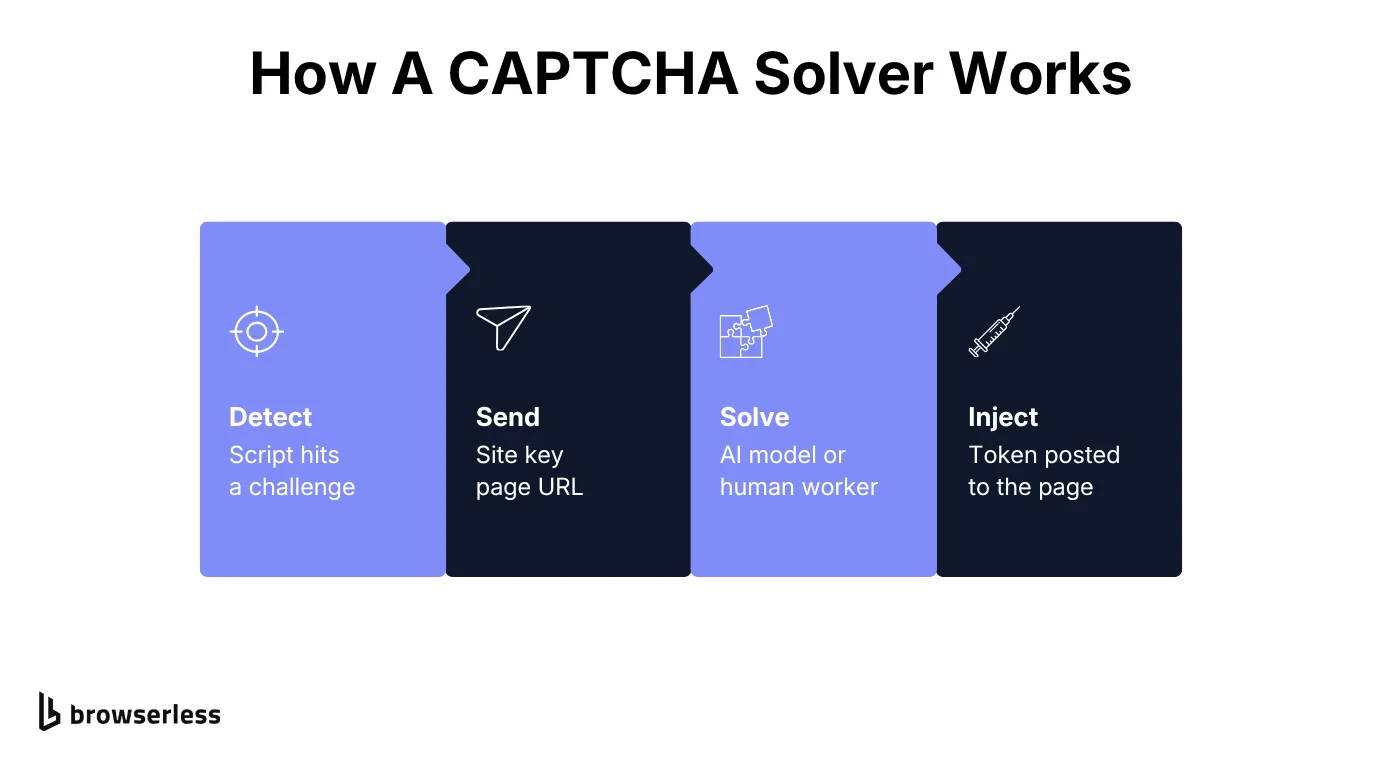
Human-relay services hand the challenge to a paid worker, which copes well with brand-new formats but costs you a few seconds per solve. AI-based services use trained models and OCR, which is faster and cheaper at scale right up until a site ships something new and the model hasn't caught up.
The tools below mostly blend the two, trying AI first and falling back to a human when confidence drops. They all claim high success rates either way, which is why this guide's ratings come from somewhere else.
A CAPTCHA is one signal among request patterns, browser fingerprints, and IP reputation, and a dedicated API only returns the token. You still need web scraping or browser automation logic to reach the page, spot the challenge, and submit the result.
The order below follows that split, with dedicated solving services first, then the extensions and platforms that treat CAPTCHAs as one part of a bigger job.
CAPTCHA challenges cluster in a few predictable places, mainly account creation forms, checkout flows, and any page a scraper hits while collecting public data at scale.
Where they appear changes what you need, because a dedicated API can hand back a token from a site key alone, but a challenge that only fires after full JavaScript rendering needs a real browser to reach it at all. Plenty of modern challenges inspect browser rendering behavior as part of their anti bot bypass logic.
Common CAPTCHA types, from reCAPTCHA v2 to Cloudflare Turnstile
reCAPTCHA v2 and v3 account for most of what you'll hit. v2 is the checkbox and image grid you already know, while v3 scores behavior silently and never shows a widget.
Cloudflare Turnstile runs a non-interactive check that usually clears without input, Amazon WAF guards AWS-fronted sites, and GeeTest turns up on Asia-Pacific properties. Plain image-based CAPTCHAs still lurk on older forms.
Difficulty stacks as well, and a page that layers Cloudflare CAPTCHAs on top of a DataDome check is a different problem from one image challenge on an old form. Difficult CAPTCHAs like those are why coverage varies so much between tools.
How many of these a tool handles is the thing to watch in the comparison below. Coverage is where these services genuinely differ, and the ones that take on various CAPTCHA types get there by different routes: a trained AI model, a human relay, or a hybrid that tries the model first.
Before you automate around a CAPTCHA
Solving a CAPTCHA removes a technical barrier, not a legal one. Bypassing CAPTCHAs can still breach the terms of service you accepted when you loaded the site, and collecting publicly available data sits on firmer ground than automating past a login you aren't authorized to use.
Check the target's terms and robots.txt before you wire up any of the tools below. It's part of the integration work, not an afterthought.
The best CAPTCHA solvers compared
The table below uses one rating per tool, sourced from an independent platform rather than a vendor's own "accuracy" claim. GitHub stars cover the open-source and open-repo tools; Trustpilot covers the closed-source commercial services, read from Trustpilot itself rather than from a badge on the vendor's site, and checked on August 27, 2026.
Review counts are included because they change what a score means. A 3.8 from 7 reviews and a 4.7 from 204 are not the same kind of number. 2Captcha's score is listed as withheld because Trustpilot is currently suppressing it over a guidelines breach, despite the 2,672 reviews behind it.
| Tool | Category | Description | Rating |
|---|---|---|---|
| 2Captcha | General automation, API | Human-plus-AI solving service built into 4,500+ third-party tools, with SDKs in 8 languages. | Trustpilot: score withheld (2,672 reviews) |
| Anti-Captcha | General automation, API | Human-worker solving service running since 2007, with a browser plugin for Chrome, Firefox, and Safari. | Trustpilot: 4.7/5 (204 reviews) |
| CapMonster Cloud | General automation, API | AI-powered solving API from ZennoLab that bundles proxy cost into its per-solve pricing. | Trustpilot: 4.6/5 (105 reviews) |
| CapSolver | Python, API, extension | AI-based solving platform rebuilt in 2026 around data-workflow automation, with multi-language SDKs. | Trustpilot: 3.1/5 (117 reviews) |
| DeathByCaptcha | API | Hybrid AI-OCR and human-solver API with 17+ years in production and client libraries in 10 languages. | Trustpilot: 3.8/5 (7 reviews) |
| Buster | Extension only | Free, open-source extension that solves reCAPTCHA audio challenges via speech recognition. | GitHub: 9.3k stars |
| NopeCHA | Extension, API | AI-powered solver available as a free-tier browser extension or a standalone Token API. | GitHub: 11.0k stars* |
| Browserless | General automation, Python, API | Browser automation platform (Puppeteer, Playwright, BrowserQL) with a built-in solve capability for CAPTCHAs it meets mid-automation. | GitHub: 13.6k stars** |
*NopeCHA's extension moved to a closed-source release model in 2023; the star count reflects the public repository, which still ships release notes and the archived legacy source.
**Browserless is not a dedicated CAPTCHA-solving service. Its GitHub stars reflect the open-source browser automation project as a whole; solving is one capability inside it, covered in its own section below.
Best CAPTCHA solvers for general automation and browser workflows
If you want one service that plugs into whatever you're already running, whether that's Selenium, Puppeteer, Playwright, or another of the popular automation frameworks, these three are the broadest options.
Each handles multiple CAPTCHA types and has been in production long enough to have weathered real format changes. All three are built for large-scale automation, not the occasional one-off solve.
2Captcha
Best for: maximum compatibility with whatever automation framework or third-party tool you already use.
2Captcha runs an AI-first solving pipeline with a human fallback. A trained model handles most tasks, and anything it isn't confident about goes to a human worker.
That combination is why it covers an unusually wide range of CAPTCHA types, from the mainstream (reCAPTCHA v2/v3, Cloudflare Turnstile, Amazon CAPTCHA) to the niche (ALTCHA, Friendly Captcha, Tencent, Prosopo Procaptcha, and several region-specific text formats).
2Captcha's real advantage is reach, and the numbers carry it. It ships official SDKs in eight languages on GitHub and is already built into more than 4,500 third-party scraping tools, browser extensions, and automation frameworks.
There's a decent chance whatever you're already running has a 2Captcha integration waiting, rather than one you have to write.
Pricing is pay-per-solved-CAPTCHA, so there's no subscription commitment and nothing to pay when a solve fails. Image CAPTCHAs start around $0.50 to $1 per 1,000, reCAPTCHA v2 runs $1 to $2.99, and Cloudflare Turnstile sits at $1.45.
Features
- Chrome, Firefox, and Edge browser extensions that solve reCAPTCHA directly in the browser without writing any API code.
- Live capacity counters per CAPTCHA type (for example, over 11,000 free workers per minute for reCAPTCHA v2) so you can gauge queue depth before you commit to a job.
- Dedicated demo pages for every supported CAPTCHA type, so you can test a solve before writing integration code.
- Supports use cases beyond scraping directly, including automated QA and security testing, OCR-based data digitization, and accessibility tooling for visually impaired users.
| Pros | Cons |
|---|---|
| Widest CAPTCHA-type coverage of any tool in this comparison | Human-in-the-loop fallback means solve times can spike under heavy load |
| No subscription lock-in – pay only for solved CAPTCHAs | Support runs through email and community channels rather than a named live chat window |
| Built into thousands of third-party tools, so integration is often zero-effort | reCAPTCHA Enterprise and other harder types cost noticeably more per 1,000 |
Anti-Captcha
Best for: teams that want a long production track record and prefer human-solved accuracy over an AI-first approach.
Anti-Captcha has run continuously since 2007, which makes it one of the oldest services in this comparison, and it solves every CAPTCHA with a human worker rather than a machine-learning model first.
The all-human path is a deliberate trade rather than a limitation, and you wait longer on every solve to get it. In exchange you sidestep the accuracy dip an AI model hits when a site ships a new format overnight, and you get high accuracy on the formats it does cover.
The service covers reCAPTCHA v2 and v3, image-based CAPTCHAs, Cloudflare Turnstile, GeeTest, Arkose Labs (FunCaptcha), Amazon WAF, Altcha, Friendly Captcha, and Prosopo, plus custom task types for anything that doesn't fit a standard category.
A browser plugin covers Chrome, Firefox, and Safari, and it drops into iMacros, Puppeteer, and Selenium without extra configuration. Anti-Captcha is also explicit that its workforce is a real, paid one rather than a fully automated pipeline, and it links to worker testimonials on its site.
You're paying for human attention on every solve, so factor the latency into your budget. That's part of why pricing sits a step above the cheapest AI-first options here.
Features
- 100% human-solved workforce, with no AI or OCR layer in the solving path itself.
- Browser plugin available for Chrome, Firefox, and Safari, including integration guidance for iMacros, Puppeteer, and Selenium.
- Publishes an
llms.txtfile specifically for AI agent integration. - Assists visually impaired users directly through the browser plugin, framed as an accessibility tool as much as an automation one.
| Pros | Cons |
|---|---|
| Longest continuous track record in this comparison (since 2007), and its highest Trustpilot score at 4.7 from 204 reviews | Fully human-solved, so per-solve latency is higher than an AI-first competitor |
| Pricing starts low for basic image CAPTCHAs ($0.50 per 1,000) | reCAPTCHA Enterprise jumps sharply to $5 per 1,000 |
CapMonster Cloud
Best for: teams that want proxy cost bundled into CAPTCHA pricing instead of managing a separate proxy bill.
CapMonster Cloud, built by ZennoLab, is an AI-powered CAPTCHA solver that bills itself as a reliable API built for scale, serving everyone from individual developers to enterprise workloads.
Its coverage list runs deep enough to be worth reading in full. reCAPTCHA v2, v3, and Enterprise, Cloudflare Turnstile and Bot Challenge, DataDome, GeeTest, Yidun, Tencent, and Amazon WAF each carry a per-1,000-token price with proxy cost already folded in.
That bundling is what sets it apart from most of the API-first services here, which expect you to bring your own proxy pool and handle proxy rotation yourself.
reCAPTCHA v2 starts at $0.60 per 1,000 tokens (or $0.04 per 1,000 for the lighter image-only path), reCAPTCHA v3 runs $0.90 per 1,000, and Cloudflare Turnstile sits at $1.30 per 1,000, with stated success rates of 97 to 99% across the supported types.
Integration runs through a plain JSON API with official SDKs for C#, Python, JS, Go, and PHP, alongside browser extensions for Chrome and Firefox for teams that want CAPTCHA handling without writing any integration code at all.
CapMonster Cloud also publishes an explicit ethical-use policy limiting the service to legitimate business purposes, testing your own site, and accessibility use cases.
Features
- Browser extensions for Chrome and Firefox alongside the API, for teams that don't want to write integration code.
- $0.10 free test balance available on request, plus a 5,000-CAPTCHA testing bonus for ZennoPoster users.
- 3-day refund window, plus affiliate and balance-bonus programs if those matter to you.
- Rated 4.6 on Trustpilot across 105 reviews, the highest of the AI-first services compared here.
| Pros | Cons |
|---|---|
| Bundled proxy pricing removes a separate cost line most competitors leave to you | API-only core product – no built-in visual workflow beyond the extension |
| Trustpilot 4.6 from 105 reviews, a real sample rather than a handful | Dashboard and setup lean technical compared to a fully no-code tool |
| Wide type coverage including DataDome and Amazon WAF | Enterprise-tier account management requires contacting sales directly |
| Explicit ethical-use policy limits the service to legitimate use cases | Affiliate and bonus programs add complexity to the pricing page for a first-time buyer |
| 3-day refund window if the service turns out not to fit your workflow |
Best CAPTCHA solver for Python automation
If you're scripting in Python specifically, several of the services above ship an official SDK worth knowing about. 2Captcha's Python client wraps the same task types covered above, Anti-Captcha's API docs include Python examples for every task type, and CapMonster Cloud ships an official Python SDK alongside its C#, JS, Go, and PHP libraries.
Python sits alongside the C#, JS, Go, and PHP clients these solvers ship, but it's usually the first SDK a scraping-focused developer reaches for. The tool that leans hardest into this angle is CapSolver.
CapSolver
Best for: Python-based scraping and automation pipelines that need fast AI-based solving with minimal integration code.
CapSolver rebuilt its platform in 2026 around what it calls "data-driven workflows," positioning itself less as a standalone CAPTCHA API and more as a layer inside a broader web-data pipeline.
It solves reCAPTCHA v2 and v3 (including Enterprise variants), Cloudflare Turnstile and Challenge, Amazon WAF, GeeTest, MTCaptcha, and image-to-text tasks, all through an AI-based pipeline rather than a human-relay model.
The Python integration is a thin wrapper over that API. Install the official package, set an API key, and call a single solve function with a task dictionary describing the CAPTCHA type, site key, and target URL.
A minimal version of that flow looks like this:
import os
import time
import requests

API_KEY = os.environ["CAPSOLVER_API_KEY"]
BASE_URL = "https://api.capsolver.com"


def solve_recaptcha_v2(website_url: str, website_key: str) -> str:
    create_payload = {
        "clientKey": API_KEY,
        "task": {
            "type": "ReCaptchaV2TaskProxyLess",
            "websiteURL": website_url,
            "websiteKey": website_key,
        },
    }
    create_response = requests.post(f"{BASE_URL}/createTask", json=create_payload)
    create_result = create_response.json()
    if create_result.get("errorId"):
        raise RuntimeError(create_result["errorDescription"])
    task_id = create_result["taskId"]

    for _ in range(20):
        time.sleep(3)
        result_payload = {"clientKey": API_KEY, "taskId": task_id}
        result_response = requests.post(f"{BASE_URL}/getTaskResult", json=result_payload)
        result = result_response.json()
        if result.get("status") == "ready":
            return result["solution"]["gRecaptchaResponse"]

    raise TimeoutError("CAPTCHA solve did not complete in time")
createTask hands over the site key and page URL and gets a task ID back, then you poll getTaskResult until the token shows up. Solving isn't instant, which is why the answer arrives on that second request rather than in the first response.
The loop matters as much as the calls do. Twenty attempts three seconds apart give a stuck task about a minute before it raises, so a bad solve fails loudly instead of quietly hanging the worker that called it.
CapSolver also ships a browser extension for Chrome and Firefox for teams that want CAPTCHA handling without touching the API at all, and multi-language SDKs beyond Python for Node.js, Java, and several others.
Per-1,000 pricing runs from $0.40 for ImageToText up to $1.20 for Cloudflare Turnstile and Challenge, with reCAPTCHA v2 at $0.80 and v3 at $1.00. Enterprise customers can request a custom plan through sales rather than the self-serve dashboard.
Features
- Official Python SDK on GitHub, plus SDKs for Node.js and other major languages.
- Integration guides specifically written for Selenium, Playwright, Puppeteer, and n8n.
- Compliance badges for CCPA, GDPR, and ISO on the enterprise tier.
- 24/7 priority support with a dedicated account manager on enterprise plans.
| Pros | Cons |
|---|---|
| Broadest SDK and integration-guide coverage of the AI-first services here | Lowest Trustpilot score in this comparison at 3.1 from 117 reviews, well below CapMonster and Anti-Captcha |
| AI-first solving keeps typical solve times under 3-5 seconds | Official Python SDK's own GitHub repository has a small star count relative to CapSolver's user base |
| Broad compliance certification set aimed at enterprise buyers | 2026 platform rebuild means some older integration guides may reference the prior interface |
| Package pricing available for teams that outgrow pay-per-use | Package pricing adds a second pricing model to compare against the base per-1,000 rates |
Best CAPTCHA solver APIs
If you're building infrastructure rather than a one-off script, what matters is how long the CAPTCHA solver API has been in production and how many languages it speaks. DeathByCaptcha wins on both counts, with 17 years behind it and client libraries in ten languages.
DeathByCaptcha
Best for: infrastructure teams that want a long-running, API-first service with client libraries for nearly any backend language.
DeathByCaptcha has run for more than 17 years, combining AI-based OCR with a 24/7 human-solver team for a hybrid pipeline similar to 2Captcha's, built with reliability as the priority over raw solving speed.
It claims over 90% correctness, bills you only for the ones it gets right, and quotes an average of 6 seconds for normal CAPTCHAs against 18 seconds for reCAPTCHA v2/v3.
The type coverage is unusually broad for a service this old, spanning normal text CAPTCHAs, reCAPTCHA v2/v3/Invisible, GeeTest v3/v4, Cloudflare Turnstile, TextCAPTCHA, CyberSiara, Cutcaptcha, Capy Puzzle, audio CAPTCHAs, Lemin, MTCaptcha, Amazon WAF, Friendly Captcha, DataDome, Tencent, and Atb CAPTCHA.
Client libraries exist for C, PHP, Python, C#, VB, Java, Perl, Node.js, C++, and AutoIt, which is more language coverage than most competitors bother shipping.
Pricing runs from $0.59 per 1,000 for audio CAPTCHAs and $0.99 to $2 for normal ones, with most specialized types at $2.89. A loyalty points program and a 10% crypto discount sit on top of that, and a live status page shows current solving speed and server health.
Features
- Client libraries in 10 languages, the broadest set in this comparison.
- Live public status page showing real-time solving speed per CAPTCHA type.
- DBC Points loyalty program with discounts on bulk orders and crypto payments.
| Pros | Cons |
|---|---|
| 17+ years of continuous production history | Only 7 Trustpilot reviews behind its 3.8, too thin a sample to lean on either way |
| Pay only for correctly solved CAPTCHAs, per its stated 90%+ correctness rate | Live chat support only runs Monday to Friday, 10am to 4pm EST |
| Broadest client-library language coverage of any tool here | Website design and dashboard feel dated next to newer competitors |
Best CAPTCHA solver browser extensions
Four of the services above ship a companion extension alongside their API. If you're specifically after the best CAPTCHA solver extension – free, extension-first, and purpose-built for that job rather than an API with an extension bolted on – these two are worth a direct look.
Buster
Best for: developers who want a free, open-source way to clear reCAPTCHA audio challenges without signing up for anything.
Buster is a free, open-source browser extension that solves reCAPTCHA's audio challenges using speech recognition, triggered by clicking the extension's button at the bottom of the reCAPTCHA widget.
It's deliberately narrow in scope, targeting the audio-challenge accessibility path specifically rather than the visual image-based CAPTCHAs the other tools here handle. Its own developer is upfront that solving more than a couple of challenges a day can trigger a temporary block.
The project is maintained by a single developer (armin.dev) and funded through Patreon, PayPal, and Bitcoin donations rather than a commercial pricing tier. An optional companion client app simulates additional user interactions to improve the extension's success rate, and it's available for Chrome, Edge, Firefox, and Opera.
The comparison table rates Buster on GitHub stars, since the repo is public. The Chrome Web Store tells a different story about day-to-day use, where it holds 3.8 out of 5 across 917 reviews and reports over 700,000 users.
Features
- Fully open source under the GPL-3.0 license, so the entire solving logic is auditable.
- Optional desktop client app for Windows, Linux, and macOS that improves success rate through simulated interactions.
- No account, sign-up, or API key required to use it.
- Available across four browsers: Chrome, Edge, Firefox, and Opera.
- Actively maintained: version 3.4.0 shipped an update as recently as June 2026, not an abandoned side project.
| Pros | Cons |
|---|---|
| Completely free, with no usage cap tied to a paid tier | Solves audio reCAPTCHA challenges only, not image-based or other CAPTCHA types |
| Fully open source and auditable (9.3k GitHub stars, 690 forks) | Frequent use in a single day risks a temporary block, by the developer's own admission |
| No account or API key needed to start using it | Maintained by a single developer, with support routed through GitHub issues rather than a dedicated team |
| Cross-browser support for Chrome, Edge, Firefox, and Opera | No official API, so it can't be called from a headless backend without a browser in the loop |
| Success rate improves further with the optional desktop client app | The optional client app is a separate install per machine, not a one-click extension setting |
NopeCHA
Best for: teams that want a free-tier extension today with a clear upgrade path to an API for headless or high-volume use.
NopeCHA is an AI-powered CAPTCHA solver built around continuous model updates. Its team runs an online reinforcement-learning pipeline that reportedly starts adapting to a new CAPTCHA format the moment it's released, rather than waiting for a scheduled retraining cycle.
The browser extension works in both Chrome and Firefox and is compatible with Selenium, Puppeteer, and Playwright when loaded into an automated browser session. It's free for up to 100 recognitions every 24 hours with no sign-up or API key required.
Coverage spans reCAPTCHA, Arkose FunCAPTCHA, AWS WAF CAPTCHA, GeeTest, Lemin, text-based CAPTCHAs, and PerimeterX's Human challenge, split across two endpoints. A Recognition API returns the answer, and a Token API returns a ready-to-submit token for teams that want to skip the extension entirely and call the API directly from their own backend.
A built-in retry delay keeps repeated calls from tripping the API's own rate limits during a burst of solves. NopeCHA's extension moved to a closed-source release model in 2023 to protect its detection logic from abuse, though its legacy 0.3.x codebase remains archived and MIT-licensed for reference.
The service reports over 1 million users and prices paid usage starting at roughly 90,000 recognitions per dollar, making it one of the cheaper AI-based options once you're past the free tier.
Dropping it into an existing Selenium Grid takes no code. Load the extension into the automated browser's profile the same way you would any other extension, and it starts solving on the pages it recognizes. On a managed platform the path differs, and Browserless for instance takes a ZIP upload from the dashboard plus a launch.extensions name, on Chromium and the default context only.
Features
- Free tier covers 100 recognitions per day per IP address, with no account required to start.
- Separate Recognition API and Token API, so headless backends can skip the browser extension entirely.
- Official Python and Node.js SDKs, alongside the browser extension.
- "Super stealth" positioning aimed at avoiding detection as an automated solver itself.
- Active release cadence, with version updates shipping roughly every month or two through 2026.
- Discord-based developer community and public activity monitor for tracking your own usage.
- Public API reference documenting every supported CAPTCHA type and endpoint.
| Pros | Cons |
|---|---|
| Genuinely usable free tier with no sign-up required to start | Extension source code is closed as of 2023, unlike Buster's fully open model |
| 90,000 recognitions per dollar is among the cheapest paid tiers here | Free tier's 100-recognition daily cap is tight for anything beyond light testing |
| Token API lets headless backends skip the browser extension entirely | Newer AI models can lag on a CAPTCHA format released within the last few days |
| Discord community and public activity monitor make usage easy to track | Free-tier usage without an API key is counted per IP address, which can undercount on shared or rotating IPs |
Best CAPTCHA solving service for automation you already run
Every tool above is something you add to your stack. There's one more case worth covering, where the CAPTCHA turns up mid-run in an automation you're already paying to operate, and the solver is already sitting in the platform running it.
Browserless
Best for: teams already automating a browser with Puppeteer, Playwright, or BrowserQL who hit a CAPTCHA on a target page and don't want to wire in a third-party solving vendor for it.
Browserless isn't a dedicated CAPTCHA-solving service, and it shouldn't be read as a direct alternative to 2Captcha, CapSolver, or the other services above.
It's browser automation infrastructure, a platform for running Puppeteer, Playwright, or its own BrowserQL language against managed Chrome instances in the cloud or self-hosted. CAPTCHA handling is built in as one capability among several bot-detection tools rather than the product itself.
That distinction matters most where a dedicated service gets awkward. When a CAPTCHA appears mid-run in a Puppeteer or Playwright session you already have open, adding solveCaptchas=true to the connection URL clears it inline, with no detour through a second vendor or a different endpoint. Register a listener for the Browserless.captchaAutoSolved CDP event before you navigate, though, and submit the form only once it fires, or the script races ahead of the token.
For orchestrated, multi-step flows there's BrowserQL's solve mutation, which handles Cloudflare, reCAPTCHA v2 and v3, GeeTest, DataDome, Akamai, and Amazon WAF challenges, along with image and text CAPTCHAs. Its type list runs to 21 entries, so the ones named here are a sample rather than the ceiling.
Navigation and solving happen in one round trip, and you don't name the challenge type. The mutation below loads a public test page that sits behind a Cloudflare challenge, then asks for whatever it finds there:
mutation SolveCaptcha {
  goto(url: "https://nowsecure.nl") {
    status
  }
  solve {
    found
    solved
    time
  }
}
Run against a live Cloudflare challenge, that returns whether a challenge was found, whether it cleared, and how long it took in milliseconds:
{
  "data": {
    "goto": { "status": 200 },
    "solve": { "found": true, "solved": true, "time": 26201 }
  }
}
Solve time varies with the challenge type and how loaded the target is, so treat that figure as one observation rather than a benchmark.
The same mutation runs from Python over plain HTTP, which is the quickest way to fold solving into an existing script:
import os
import requests

TOKEN = os.environ["BROWSERLESS_TOKEN"]
ENDPOINT = f"https://production-sfo.browserless.io/chromium/bql?token={TOKEN}"

QUERY = """
mutation SolveCaptcha {
  goto(url: "https://nowsecure.nl") {
    status
  }
  solve {
    found
    solved
    time
  }
}
"""

response = requests.post(ENDPOINT, json={"query": QUERY}, timeout=120)
response.raise_for_status()
result = response.json()

if "errors" in result:
    raise RuntimeError(result["errors"][0]["message"])

print(result["data"]["solve"])
The raise_for_status and errors checks matter more than they look. BQL answers a bad token or a malformed mutation with a 200 and an errors array, so without that second check a failed solve returns a cheerful None and the script carries on as though it worked.
Browserless also ships a Playwright-shaped Python SDK that wraps the same mutation, if you would rather write page.solve() than assemble the query yourself.
Solving sits alongside a stealth route that mitigates the browser fingerprints anti-bot systems check for in the first place, and residential proxies with IP rotation for reputation-based blocks. When auto-solving fails, a liveURL mutation hands back a URL a person can open and solve by hand.
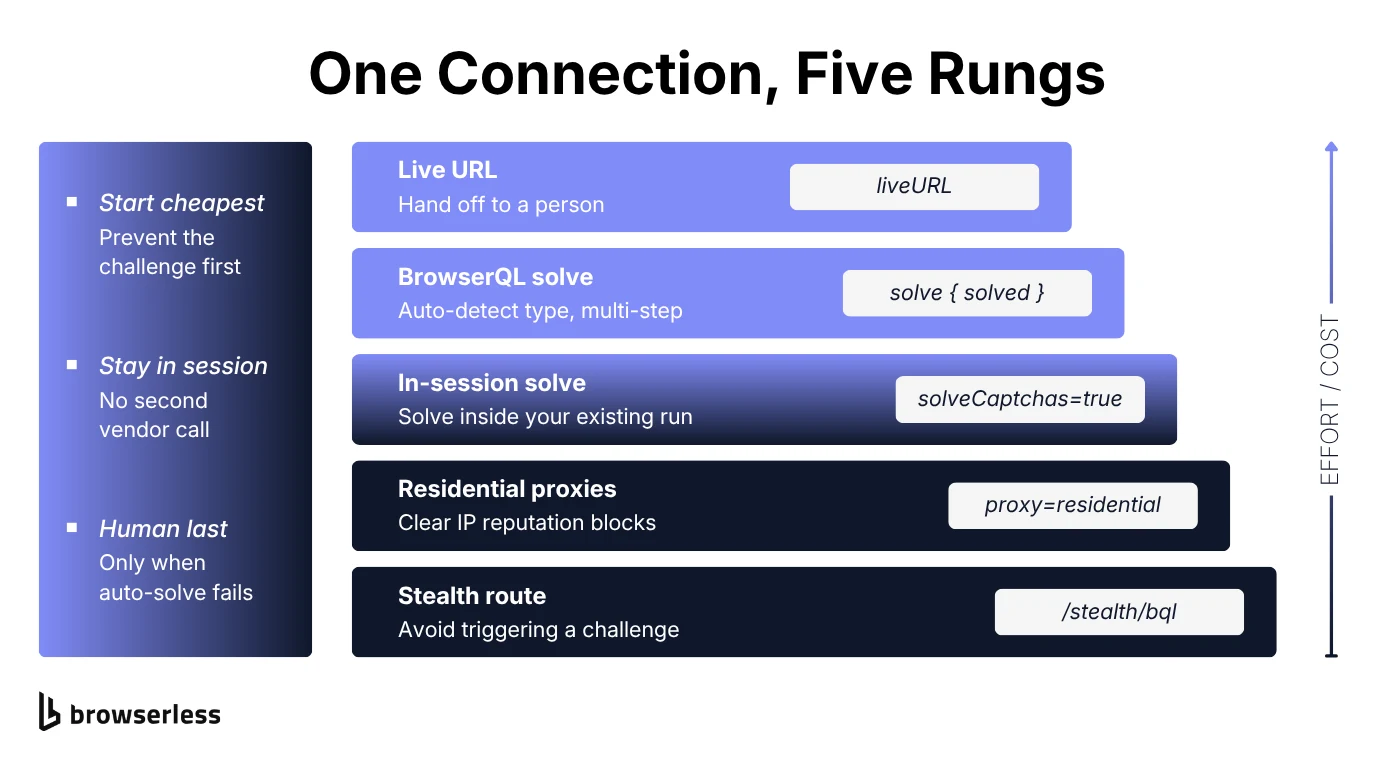
The scope limit is a real one, not a disclaimer. If you need a standalone CAPTCHA-solving API to call from infrastructure that has nothing to do with browser automation, one of the dedicated services above is the better fit.
Features
solvemutation auto-detects the CAPTCHA type on the page, so you rarely need to specify one manually.solveImageCaptchahandles legacy, custom image-based challenges that standard detection can't identify.- Stealth route (
/stealth/bql) applies fingerprint mitigations and entropy injection, which lowers the odds of a challenge without removing it as a possibility. - Residential and datacenter proxy support for IP-based blocks, billed per MB alongside CAPTCHA solving.
- Chrome Extension support for loading third-party ad blockers or other tooling into the same automated session.
- MCP server support for connecting AI assistants and agent frameworks directly to the same browser infrastructure.
| Pros | Cons |
|---|---|
| CAPTCHA solving is built in, with no separate vendor account to set up | Not a standalone CAPTCHA-solving API – you need a browser automation use case for it to make sense |
| One connection covers solving, stealth, and proxies instead of three separate vendor integrations | Billed in units rather than a flat per-1,000 rate: 10 units per successful solve, plus 1 unit per 30 seconds of browser time and 6 units/MB for residential proxy traffic |
| 175M+ Docker pulls back the underlying browser infrastructure | Solving is one capability inside a broader platform, so there's more surface area to learn than a single-purpose API |
| Self-hosted deployment available for compliance or data-residency requirements | |
Inline solveCaptchas=true, BrowserQL solve, and a liveURL human fallback cover different failure modes | |
| Same connection also runs your existing Puppeteer or Playwright scraping and testing code |
Conclusion
There's no single best CAPTCHA solver, only the right CAPTCHA solver for what you're building. Two questions settle it faster than any feature list: which challenge types your targets serve, and whether you already have a browser in the loop.
Answer those and the shortlist picks itself, but test before you commit. None of these are reliable solutions against every bot-detection setup, solid accuracy on one CAPTCHA type doesn't carry to the next, and one real solve against a real page beats any comparison table, this one included. Keep other solvers on the list as a fallback, and if the CAPTCHA is interrupting automation you already run, sign up for Browserless free.
Best CAPTCHA solver FAQs
Are CAPTCHA solvers legal?
Using a CAPTCHA solver isn't illegal in itself, but it can breach the terms of service you accepted when you loaded the site, which is the line bypassing CAPTCHA has to stay on the right side of. That's a contract question rather than a criminal one, and what sits behind the challenge matters more than the solve itself. Public data carries a different risk profile from an account you aren't authorized to access.
Can ChatGPT solve CAPTCHAs?
General-purpose chatbots aren't built for this and are unreliable for live CAPTCHA solving. The tools in this comparison exist specifically because purpose-built AI models, trained on CAPTCHA-solving data and continuously updated as formats change, perform meaningfully better than a general model asked to do the same task on the fly.
Is there a free CAPTCHA solver?
Buster is free with no usage cap tied to a paid tier, and NopeCHA offers a free tier of 100 recognitions per day without requiring sign-up. The dedicated solving APIs above don't run unlimited free tiers, but several let you test a small number of solves before committing to a paid plan.
Is there an AI-powered CAPTCHA solver available?
CapSolver, CapMonster Cloud, and NopeCHA all lead with AI-based solving rather than a human-relay model, while 2Captcha and DeathByCaptcha use AI as a first pass before falling back to a human worker. Anti-Captcha is the one exception in this comparison, relying on a fully human-solved workforce by design.
Do CAPTCHA solvers offer unlimited plans or an SLA?
Not really, and it's worth knowing before you budget. None of the services here sells unlimited monthly plans. Pricing is pay-per-solve or prepaid packages, and DeathByCaptcha's $4.99 GOLD membership is the only flat subscription in the group, which is not the same as unlimited plans.
No vendor here publishes a service level agreement or anything resembling outage insurance either. Anti-Captcha advertises 99.99% uptime since 2007 and CapMonster Cloud quotes 97 to 99% success rates, but those are marketing figures rather than contractual commitments. CapSolver and CapMonster both route enterprise buyers through sales, which is where you would negotiate an SLA if your workload needs one.
Is CAPTCHA solver integration difficult?
Every vendor promises seamless integration, and for the common path that's roughly fair. You install an SDK, set an API key, and pass a site key and page URL.
The work tends to show up around the call rather than in it: detecting that a challenge appeared, deciding how long to poll before giving up, and injecting the token in the page context. Browser extensions skip most of that, at the cost of needing a browser in the loop.
What is the best CAPTCHA solver for automation?
For a framework-agnostic setup running Selenium, Puppeteer, or Playwright against varied targets, 2Captcha, Anti-Captcha, or CapMonster Cloud cover the broadest CAPTCHA-type range. Buster and NopeCHA suit occasional in-browser solving, and DeathByCaptcha suits a backend that needs an unusual client library.